
Principal Investigators: Dai Shizuka, Maria Stager (UMass Amherst)
Personnel: (UNL) Angela Brierly, Traysea Malama-Auger, Aidan Hand, Faiza Hafeez, Darian Pierre, etc. (UMass) Akshiti Bhat, Wentao Yang, etc.
Funding Source: NSF IntBIO (2316373 to D.S. and 2316374 to M.S.)
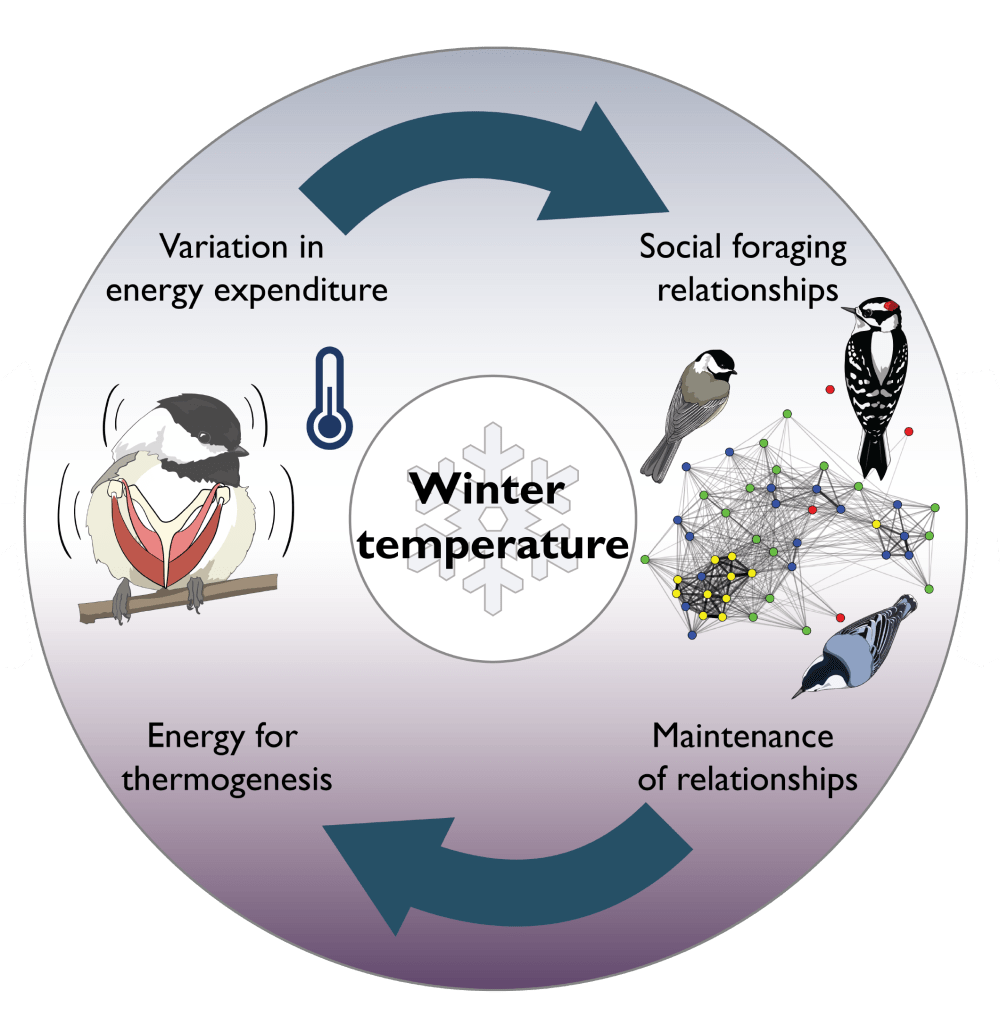
If you live in a temperate climate like much of North America, you may have at some point watched a small bird flittering around outside in the middle of the winter and asked, how are they surviving out there? Small winter-resident birds must maintain high temperature in extremely cold air temperatures and scarce resources. They must maintain a tight energy budget that ensures they do not freeze to death overnight, while also being able to avoid predators. This incredible biological feat right outside our windows have inspired me and my collaborator, Maria Stager at University of Massachusetts Amherst to study wintering birds. I had been approaching this question using tools of behavioral ecology: crafting ways to collect data on how animals behave in the wild. In this case, our lab had started to use RFID-enabled bird feeders to study the daily feeding patterns and social networks of wintering birds in Nebraska (e.g., black-capped chickadee, white-breasted nuthatch, downy woodpecker, etc.) to ask questions such as, how do social relationships influence individual’s behavioral responses to cold temperatures (Madsen, Vander Meiden, & Shizuka 2021)? We also studied how use of acoustic signals influenced food finding in mixed-species flocking birds (Hafeez et al., forthcoming). On the other hand, Dr. Stager had conducted seminal studies on metabolic flexibility and thermogenesis in small wintering birds like dark-eyed juncos (see Dr. Stager’s google scholar profile). In 2023, we received a collaborative grant to join forces to study the feedback between social behavior and thermal physiology using winter resident mixed-species flocking birds in Nebraska and Massachusetts. We are innovating how we study body temperature in birds in the wild while we also measure their foraging and flocking behavior, and we will be conducting experiments to test hypotheses about how overnight thermal demands drive intra- and interspecific social foraging, and how social foraging dynamics may influence the ability to regulate overnight body temperature.
Together this work will advance our understanding of the feedback between individual phenotypic variation and community social dynamics. This project will focus on broader impacts activities in four main areas: (1) Improving training and inclusivity in STEM through research experience for undergraduates, baccalaureate students, and graduate students across two universities, (2) Improving undergraduate STEM education through integration of course-based undergraduate research experiences, (3) Improving middle school STEM education through the production of scalable, high-production, interdisciplinary lesson plans for grades 6-9 that meet U.S. Next Generation Science Standards, and (4) Public engagement through field activities and presentations.
 Shizuka Lab