
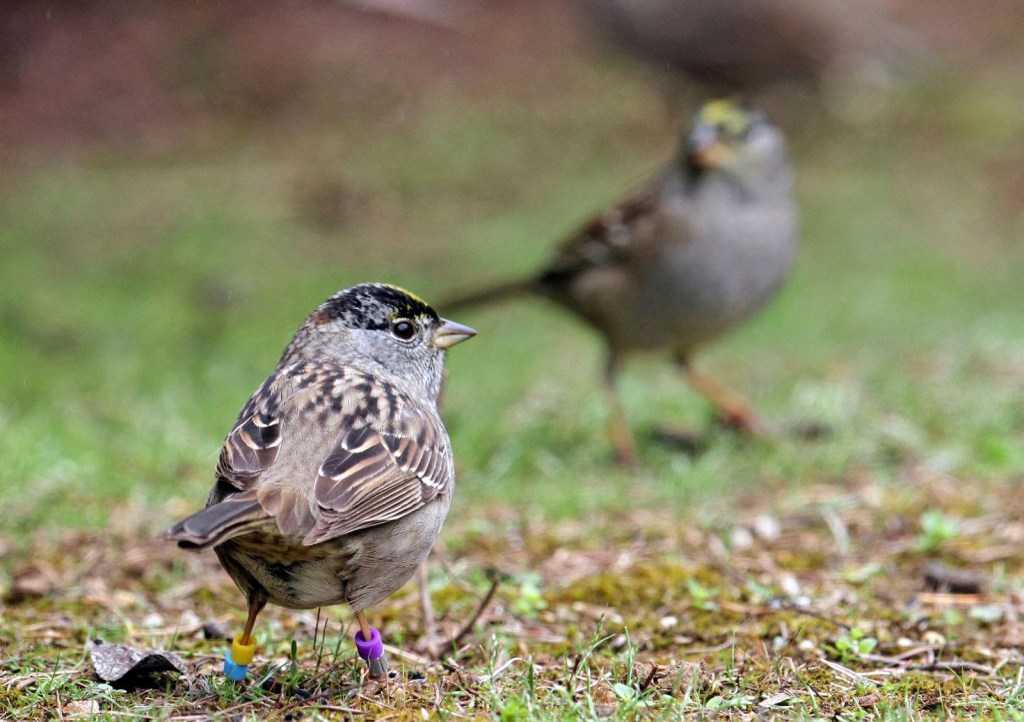
Principle Investigators: Dai Shizuka, Bruce Lyon (UCSC), Alexis Chaine (CNRS)
Personnel: Nina Arnberg (UCSC), Theadora Block (UCSC), Annie Madsen (UNL), Mary de Aquino, Angela Brierly, Julie Chase (field coordinators), plus countless undergrads and field interns!
Funding Sources: National Geographic Society grant WW-012R-17; NSF CAREER grant
IOS-1750606 to D.S.
This project started as a collective side project for me, my then-advisor Bruce Lyon and then-labmate Alexis Chaine, helping undergraduates conduct senior thesis projects using golden-crowned sparrows (Zonotrichia atricapilla), which were abundant at the UC Santa Cruz arboretum. We began by following up on classic work conducted by Sievert Rowher on the role of plumage signals in mediating competition over food resources in winter. Rowher had elegantly shown how variation in breast plumage of Harris’s sparrows (Zonotrichia querula) functioned as a ‘signal of status’ such that competitors could assess each other without engaging in costly aggressive interactions. Given that golden-crowned sparrows are close relatives of Harris’ sparrows, we asked whether they may also use signals of status. We teamed up with talented undergrads such as Kris Tjernell and Allison Roth (now faculty at University of Missouri) to show that, indeed, golden-crowned sparrows also use signals of status: albeit in the form of crown plumage (Chaine et al. 2011, 2013). Since this work was on the university campus and a good training ground for students interested in avian ecology and behavior, we continued to band and monitor the population year after year.
While engaging in this early work on signals of status, we began to notice across-year patterns, like the same birds showing up at the same bushes across multiple years. This led us to start wondering about the social system of wintering sparrows, and whether birds may actually know each other from prior years. After I gained some knowledge about social network analysis as a postdoc with David McDonald (University of Wyoming), we decided to collect data on flock composition and start building social networks. Pretty quickly, we found that, indeed, golden-crowned sparrows flock together with the same birds year after year, and that this social network was quite interesting (Shizuka et al. 2014). Soon enough, we realized that these networks are not kin-based (Arnberg et al. 2015), nor were the associates from the breeding season (Block et al. 2023)–these were exclusively winter social relationships. More recently, we showed with our long-term data that the social connections in these networks may be one key reason that the birds come back to the same bush each year (Madsen et al. 2023)!
Observing this social network of birds year after year also inspired me to think about how the long-term dynamics of ALL social networks in nature are influenced by demographic processes such as deaths, births, immigration and emigration–leading to a conceptual paper with my then-postdoc Allison Johnson (Shizuka & Johnson 2020). It’s a simple yet powerful idea: all organisms live and die, and when an individuals die, their social connections are lost as well. Likewise, when new individuals recruit to the population, they form new social connections that did not exist before. This turnover of individuals AND their connections have the potential to either sustain the structure of a social network, or reshape it completely. We currently have a couple of fantastic studies by Annie Madsen in preprint that takes this idea further in the golden-crowned sparrow social system.
 Shizuka Lab