
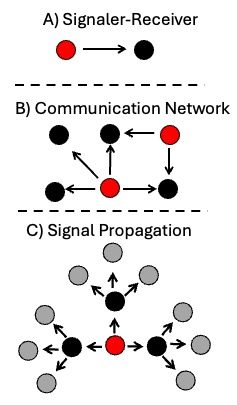
Animal communication involves more than just one signaler and one receiver–populations of individuals are connected together in a communication network.
Our work has two main aims: (1) to integrate the idea of social networks, which we largely study based on spatiotemporal proximity, with communication networks, which can bridge individuals across larger spatial and temporal scales, and (2) understand how network dynamics such as signal propagation (Figure to the left) expands the influence of individuals across groups and populations. We use acoustic communication in red-winged blackbirds as our model system.
This project is supported by NSF OIE-2608132 to D. Shizuka
Overview:
Over the past few decades, research on animal social networks and communication networks have largely developed independently as ways to understand the causes and consequences of social interactions within populations. A major challenge to integrating these concepts lies in their difference in spatial scale: social networks are often measured based on spatiotemporal proximity, while communication can occur among individuals that do not share the same space at the same time. The issue of spatial scale becomes even more complex when we consider signal propagation, in which signal receivers produce signals in response, potentially leading to a cascade of signals carrying information far beyond the active space of the initial signaler. This project will use colonies of breeding red-winged blackbirds (Agelaius phoeniceus), an abundant species with exceptionally well-studied acoustic communication and social system, to address two fundamental aims to integrate communication and social networks: (Aim 1) disentangle the interplay between acoustic communication and spatiotemporal association, and (Aim 2) determine the role of signal propagation in collective defense behavior. We will accomplish this by leveraging new technological and analytical advances in acoustic monitoring, automated tracking, and artificial intelligence (AI) and machine learning algorithms for analyzing soundscapes and radiotelemetry data. This will allow us to address Aim 1 by simultaneously tracking vocalizations and movements of individuals as they engage in natural interactions at breeding colonies, yielding both communication networks and spatiotemporal association networks. Aim 2 will use a field experiment to induce alarm call cascades under different anthropogenic noise levels to study the process of signal propagation in nature.
Intellectual Merit:
This project will deliver two groundbreaking contributions to our understanding of acoustic communication in animal systems. First, it will advance the field toward a unified conceptual framework that integrates communication networks and social networks as complementary tools for studying social systems across spatial scales. Second, it will provide the most comprehensive analysis to date of acoustic signal propagation in natural environments. In addition, our findings will shed light on how collective behavioral dynamics influence key ecological and evolutionary processes, including predator–prey interactions and coevolution. Our approach will also push forward the use of AI and machine learning for analyzing natural soundscapes. Finally, the conceptual insights gained here have broad relevance to other domains where communication networks and signal propagation are fundamental, such as neural circuits, human communication technologies (e.g., internet and wireless systems), and robotics.
Broader Impacts:
This project will focus on broader impacts in 3 key areas: (1) Building STEM talent—the research team members, including postdoc, graduate student, and at least 4 undergraduates per year, will gain practical experience in groundbreaking applications of new acoustic monitoring and automated tracking technologies and AI/machine learning approaches to mining these data. (2) Technological innovations—our research findings will reveal how evolution has shaped fundamental communication network dynamics, including coordination and signal propagation, which can have broad applications in human society including neural circuits, communication infrastructure, and robotics engineering. (3) Engaging a wider audience—this project will also result in an innovative art-science installation that will provide transformative, interactive experience of avian acoustic communication systems to public audiences. We will measure the impact of these experiences on people’s understanding of avian ecology as well as human-wildlife interactions.

